
Home > Micro Vickers Hardness Tester
Micro Vickers Hardness Tester
Products
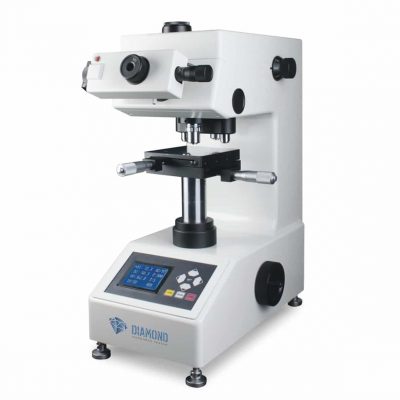
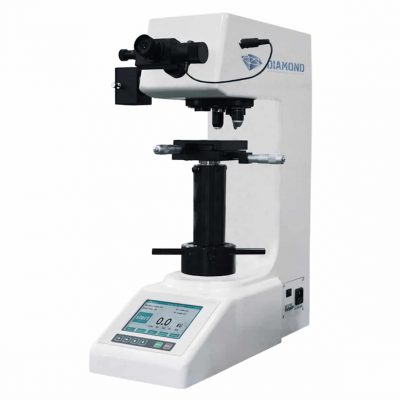
While the Micro Vickers hardness test is similar in its procedures to the standard Vickers hardness test, it is limited to loads of 1kg and below. It was introduced as a hardness testing method for materials on a smaller scale. It is most suitable for soft materials and plastics that don’t require large loads to cause an indentation but can be ideal for metals also. Like other indenter-based hardness testers, the Micro Vickers hardness tester uses a pyramid-shaped diamond indenter. Additionally, the width of the indentation produced on the material surface is measured to calculate the Vickers hardness value of the material with DPH (Diamond Pyramid Hardness) as its designation.


Why Global Clients Choose Us?
25 Years of Expertise
We have 25 years of experience in the professional production of hardness testing devices, an annual output of more than 10,000 hardness testers.
Talented Engineers and support team
As of September 2020, we have a total of 125 employees, including nearly 35 professional and technical workers who are masters or doctorate degree holders.
Advanced production equipment
We have Complete machining workshop, CNC, CNC machine tools, and more than 50 other types of processing equipment,to ensure high-precision product parts.
Excellent After-Sales Service
We provided excellent after-sales service, including fast delivery, online training, immediate feedback of trouble shotting.
Welcome to Visit us Anytime


Questions on Micro Vickers Hardness Tester
1. What is the Use of Micro Vickers Hardness Test?
Micro Vickers hardness test has a unique application in testing materials requiring very minimal loads to cause a measurable impression when the load impacts the material surface. Micro-hardness testing becomes critical for specific materials such as plastics, coatings, plating, and thin metals that are likely to damage under the load impact of macro-hardness testing. These situations often require micro-hardness tests like the Micro Vickers hardness to get accurate hardness values for these materials. In addition, the Micro Vickers hardness test is often used to determine the hardness values of case-hardened layers, grind burns, and carburization.
2. Features and Advantages of Micro Vickers Hardness Tester
With its design, the Micro Vickers hardness tester has many features that make it beneficial for users, and the most important benefits include
- Wide Range of Application – Its application includes both soft and hard metals even though it was primarily created to determine the hardness of small and thin materials, which other test methods like the Rockwell test couldn’t.
- Universal Indentation – The Micro Vickers hardness tester calibration is often very fast since the indenter is the same shape and size used for the different sample materials. The fact that the indenter is made of diamond, a solid material that is not susceptible to deformation, means replacement is unnecessary.
3. What is the Micro Vickers Hardness Calculation?
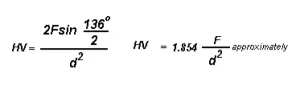
To calculate the Micro Vickers hardness value of the material, it is imperative to understand the shape of the indenter and its unique impression type. The indenter forms a 136-degree angle between its faces with the pyramid-shaped diamond and a square base. Also, the diagonal length is seven times its indentation depth. Consequently, the diagonals and depth of indentation measurements are critical when calculating the Micro Vickers hardness value. The average of the measured values is computed using the formula below, where the load is also an input in calculating the hardness value designated as HV. Another convenient method is the use of tables and charts where you can find the HV values.
Where:
F= Load in kgf
d = Arithmetic Mean of the two diagonals, d1 and d2 in mm
HV = Vickers hardness
4. How do you Test Vickers Hardness?
When carrying out the Vickers hardness test, a diamond indenter shaped like a pyramid is used to impress the surface of the test sample material using a specified load within a given time. This load is often 1kg or less when it’s a Micro Vickers hardness test, but the load can be higher for a standard Vickers hardness test. The impression resulting from the application of the load is measured across diagonals and depth. And these parameters, along with the applied load, form the inputs for calculating the Vickers hardness number of the material. However, using a microscope is essential for accurate results to take the impression measurements.
5. Test Standards
Since the Vickers test is an industry-recognized hardness testing method, it must conform to industry standards and requirements for accurate tests. The test standard for the Vickers hardness test includes the ASTM E18, which is used for metals with a similar standard found in ISO 6508, which also sets out the procedures for conducting a Vickers hardness test for metals. For plastics, the ASTM D785 is the industry standard for the Vickers hardness test with a similar standard in ISO 2039.
6. Consumables for the Micro Vickers Hardness Tester
Standard tools and features are essential to every Micro Vickers hardness tester, including
- The Indenter – This component is made of diamond with a pyramid shape, and it is arguably the most important consumable you’ll find when conducting a Vickers hardness test. It is responsible for the indentation of the material surface. Without the indentation, there would be nothing for calculating the material’s hardness value. This means the test is always consistent since it is the same indenter used, irrespective of the material.
- Optical Evaluation – An optical component is often found with a Vickers hardness tester to ensure the accuracy of the indentation measurement. This optical instrument significantly increases the cost of the Vickers hardness tester since you cannot accurately measure the indentation without it.
- Test Blocks – These blocks are often for reference purposes and to endure the accuracy of the test, especially during the calibration process. The operator can confirm the accuracy of the test machine by mounting the test blocks on it before commencing the test.
- Software Support – Software is a good way of reducing the human error effect common to most test procedures, including the Vickers hardness test. There is various software with different levels of automation that you can employ with a Micro Vickers hardness tester, removing the need for human interference with the test. This software support can significantly increase the accuracy of your test.
7. Limitations of Micro Vickers Hardness Tester
With all its advantages and unique applications in different industries, the Micro Vickers hardness tester still has some shortcomings. Hence, the major limitations you will find below.
- Price – One primary requirement for carrying out the Micro Vickers hardness test is an optical instrument to evaluate and measure the indentation created by the diamond indenter. Since these indentations are often tiny, having this optical instrument with the tester is critical. However, the optical devices are not cheap and significantly increase the cost of purchasing the Micro Vickers hardness tester.
- Extensive Material Preparation – There is often the need to prepare the contact surface of the material to ensure the results are accurate and reliable. Also, the operator might find it challenging to evaluate the indentation even with a microscope if the material surface is rough.
- Slow Test Cycles – The test speed is relatively slow when matched with tests like the Rockwell hardness test. The preparation of the material surface is often a significant contributor to the slow pace of conducting the test.
In conclusion, the Micro Vickers hardness tester is very efficient in hardness testing applications requiring minimal loads for materials that include soft metals, coatings, plastics, and plating. However, this tester has its limitations, including high cost, slow operation, and extensive material preparation. Ultimately, you want to ensure that you are selecting the right testing methods for different materials based on the accuracy required, material type, shape, and size.